

From around the world, letters and lovers travel here to Casa di Giulietta in Verona. The tale of Romeo and Juliet is commonly known to originate here, in Italy, and been popularized by Shakespeare. But to the average visitor of Verona, details of other cultures' relationship with Romeo and Juliet are few and far between. And then there is France. If you want a single proof that this story is contagious — that it knows no national bounds, and carries something in it stronger than literature, something closer to a fever or a faith — you need only follow the French.
Without the French and their love affair with Shakespeare's play — their emotional embellishments and sometimes shy interpretations of Romeo and Juliet — the Casa di Giulietta in Verona might even be different than what it is today. Read on to understand the all-encompassing love affair.
The Frenchman at the root of the English Juliet
Begin with a quiet irony that almost no visitor to Verona knows. The Juliet the whole world pictures — the young lover on the balcony — was Italian by birth, but it was the French who carried her words across the Channel to England´s Shakespeare.
From Italy's da Porto to England's Shakespeare
Around 1524, Luigi da Porto — a nobleman from Vicenza whose soldiering was ended by a war wound, leaving him to write — set down the first version we would recognize, giving the tale its home in Verona and naming the lovers Giulietta and Romeo and their feuding families the Montecchi and Cappelletti.
A generation later, Matteo Bandello — one of the most widely read storytellers of the Renaissance — retold da Porto´s story in his Novelle of 1554, polishing it into the form Europe would carry abroad -- story was Italian long before it was English.
The bridge that carried it out of Italy was a Frenchman. In 1559, Pierre Boaistuau published his Histoires Tragiques, a collection of Bandello's stories "mises en langue françoise" — put into the French tongue — and he did not merely translate the lovers' story; he reshaped it, sharpening the tragedy and adding the moral weight that later versions would inherit. His collaborator François de Belleforest carried the series on. And it was Boaistuau's French text, not the Italian, that crossed to England.
There, Arthur Brooke turned it into a long English poem, The Tragicall Historye of Romeus and Juliet (1562) — the single book Shakespeare would lean on most when he came to write his play. Five years later, William Painter retold it in English prose in his Palace of Pleasure (1567), putting the story into such wide circulation that, by Shakespeare's day, English readers already knew it well.
When Shakespeare sat down around 1595, the book open beside him was Brooke — which is to say, an Englishman's poem drawn from a Frenchman's prose drawn from an Italian's novella drawn, in the end, from a longing older than all of them.
So before France ever fell in love with the story out loud, it had already, almost without noticing, given the story the shape in which the world would come to know it. The hinge of the whole tradition is a French one — a translator doing quiet, fateful work.
The long frost: a story admired, and kept at arm's length
For a long time afterward, France loved Shakespeare the way one loves something one does not quite trust.
The eighteenth century kept him at a careful distance. Voltaire, who had encountered Shakespeare in England, spent decades both praising his power and recoiling from his wildness — famously deriding the plays, in his later campaigns, as the work of a kind of inspired barbarian, thrilling but ungoverned, unfit for the disciplined French stage. When Pierre Le Tourneur finally published a full French Shakespeare between 1776 and 1783, Voltaire was scandalized. And when Shakespeare did reach the French theatre, he arrived corseted: Jean-François Ducis, who could not read a word of English and worked entirely from French translations, produced a Roméo et Juliette for the Comédie-Française in 1772 that bent the play to neoclassical taste — the plot altered, the characters altered, the raw grief tidied into something a refined Parisian audience could bear. It was a success. It was also, in a sense, the story with its wildness combed flat: Verona's lovers admitted to the French stage only after they had been taught to behave.
There is a pattern here worth pausing on. Twice, across two centuries, France took our lovers in hand — and twice it could not quite decide what they were. Back in 1559, Boaistuau had received the tale as a moral tragedy, framing the lovers' ardor as a cautionary example, a warning dressed in sorrow — passion held at the safe distance of a lesson. Ducis, two hundred years later, held it at a different distance: the distance of good taste, combing the wildness flat to fit a drawing room. Moralized, then mannered — a sermon, then an etiquette. It is as though France kept circling the story, drawn to its fire yet afraid to be burned, translating and retranslating and never once letting it simply be.
This matters, because it makes what happened next feel less like an event and more like the floodgates opening once and for all.

The thunderclap of 1827
In September 1827, an English company under Charles Kemble took the stage at the Théâtre de l'Odéon in Paris and performed Shakespeare in English — not tamed, not translated, not corrected. On 11 September, a young Irish actress named Harriet Smithson played Ophelia in Hamlet. Four days later, on 15 September, she played Juliet.
Almost no one in that audience could follow the English closely. But here in Verona we have always known that Romeo and Juliet asks for no translation — it arrives in every tongue and lands in every heart, exactly as the letters to Giulietta still do. What the French saw needed no words: passion performed without a corset — grief that shook, love that overwhelmed, a Juliet raised to the full tragic stature of her Romeo. The young Romantic generation of Paris was in that theatre, and it came out changed. The painter Eugène Delacroix was there, already half-converted to Shakespeare by a journey to England. Alexandre Dumas was there, and would call the revelation the greatest of his life. Alfred de Vigny was there, and would soon put Shakespeare into French himself. Over them all towered Victor Hugo, whose incendiary Préface de Cromwell — the manifesto of French Romanticism, with Shakespeare enthroned as its patron saint — set the movement alight that very year. And down in the pit sat a fervid, red-haired, twenty-three-year-old composer named Hector Berlioz.
The season of 1827 is one of those rare moments where you can watch a whole culture's temperature change before your eyes. France had spent two hundred years uncertain whether to embrace the story. Now it pulled the story to its chest and would not let go.
The composer who married Juliet
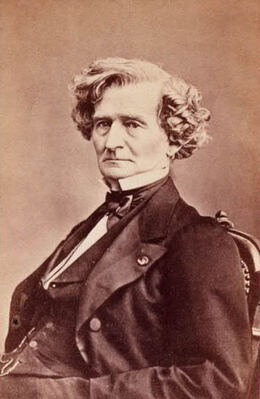
Our story of France's love affair with Romeo and Juliet continues. Of everyone in that audience, it was Hector Berlioz, the young composer, who took the fever deepest — and his is the tale that proves, beyond any argument, that this story does not stay on the page.
He watched Harriet Smithson play Ophelia and Juliet, and he was, by his own account in his Mémoires, struck down — Shakespeare falling on him "unawares," like lightning. But it was not only Shakespeare. It was her — Harriet. Berlioz fell into an obsession so total it frightened his friends: he wrote letters she did not answer, he took rooms where he might glimpse her, he made of this near-stranger the fixed point of his imagination. And because he was a composer, the obsession became music. Three years later, in 1830, he produced the Symphonie fantastique, whose recurring melody — the idée fixe, the musical thought that will not leave the mind — is Harriet Smithson: a portrait of unappeasable longing, written by a man who had barely spoken to the woman it depicts.
Then life did the thing that only this story seems able to make life do. In 1832, Smithson attended a performance of Berlioz's Lélio, the sequel to the Symphonie fantastique, and understood — sitting in the hall, hearing herself described in sound — that this music was about her. They met. Against the furious opposition of both their families, they married at the British Embassy in Paris on 3 October 1833. Their son Louis was born the next summer. This is a true story.
Hold the improbability of it. A young man goes to the theatre, sees an actress play Juliet — Juliet, of all parts, the girl who loves absolutely and dies of it — and is so overtaken that he composes his way into her life and marries her. The story had leapt clean off the stage and put on a wedding ring.1
And out of the long aftermath came the greatest tribute of all. In 1839, Berlioz wrote Roméo et Juliette, a vast "dramatic symphony" for orchestra, chorus, and soloists — not a setting of Shakespeare's words so much as an attempt to pour the entire feeling of the play into sound. It was premiered at the Paris Conservatoire on 24 November 1839, its text written by Émile Deschamps — the same Romantic poet who had helped carry Roméo et Juliette to French readers — so that two men who had shared the fever of 1827 now raised the monument together.
And here the story does something a Veronese heart cannot help but savor: it circles home to Italy.
The name at the head of that score is Niccolò Paganini — the violinist from Genoa who was, in those years, the most famous musician alive: a gaunt, black-clad, spellbinding figure whom audiences half-believed had sold his soul to the devil, so impossibly did he play. Some years before, Paganini had begged Berlioz for a showpiece to display his prized Stradivarius viola, and Berlioz had answered with Harold en Italie — a symphony steeped, as its very title says, in Italy. But the solo was not to Paganini's liking — it wandered and fell silent where a virtuoso wanted fire, and Paganini, disappointed, laid the score aside and never played a note of it in public.
Then, on a December night in 1838, he heard it performed at last. Whatever had eluded him on the page overwhelmed him in the hall, and when the final chord faded Paganini crossed to the stage and knelt before Berlioz in front of the entire audience. Two days later a letter arrived in the virtuoso's own hand: with Beethoven gone, it said, only Berlioz could carry the flame — and folded inside was a gift of twenty thousand francs. It was a fortune. It cleared debts Berlioz had, and lifted from him the grinding journalism that had been strangling his art, and bought him a stretch of freedom to write whatever his soul demanded.
What his soul demanded was Roméo et Juliette. Follow the circle it closes and you find a symmetry no storyteller would dare invent: an Italian's emotion, brimming over at an Italy-steeped symphony, freed a Frenchman to pour himself entire into the most Italian love story ever told — and Berlioz, in turn, laid that masterwork at the feet of the tale Verona keeps, as though repaying a debt to the country that had lent him both the story and the gift. The purse of Genoa, the genius of Paris, the lovers of Verona — you could not draw the lines straighter if you tried.
You can still see Berlioz's own manuscript, in his hand, its title page naming Shakespeare, Paganini, and Deschamps, in the French national library.
A man saw Juliet, married the woman who played her, and spent his life turning the story into music. There is no better answer to the question, why does this story spread? Why else would millions come to Casa di Giulietta every year, if not to feel possessed — as he was — by even a fraction of the emotion this story has carried, undimmed, across the centuries?
Please continue to read the second part of our cultural investigation of Casa di Giulietta — the letters and stories that inspire us. And if you'd like to arrange a time to visit, please follow one of the links below.
→ Part 2: The European Pilgrimage to Verona
Footnotes
-
That the marriage later darkened — that it cooled, that Berlioz drifted, that the two separated, and that Harriet died in 1854 having outlived the great passion she had unknowingly lit — does not lessen the wonder. If anything it deepens it: the story gave Berlioz not a fairy tale but a whole human fate, joy and grief entire, exactly as it gives the rest of us. ↩